
CategoriesUncategorized

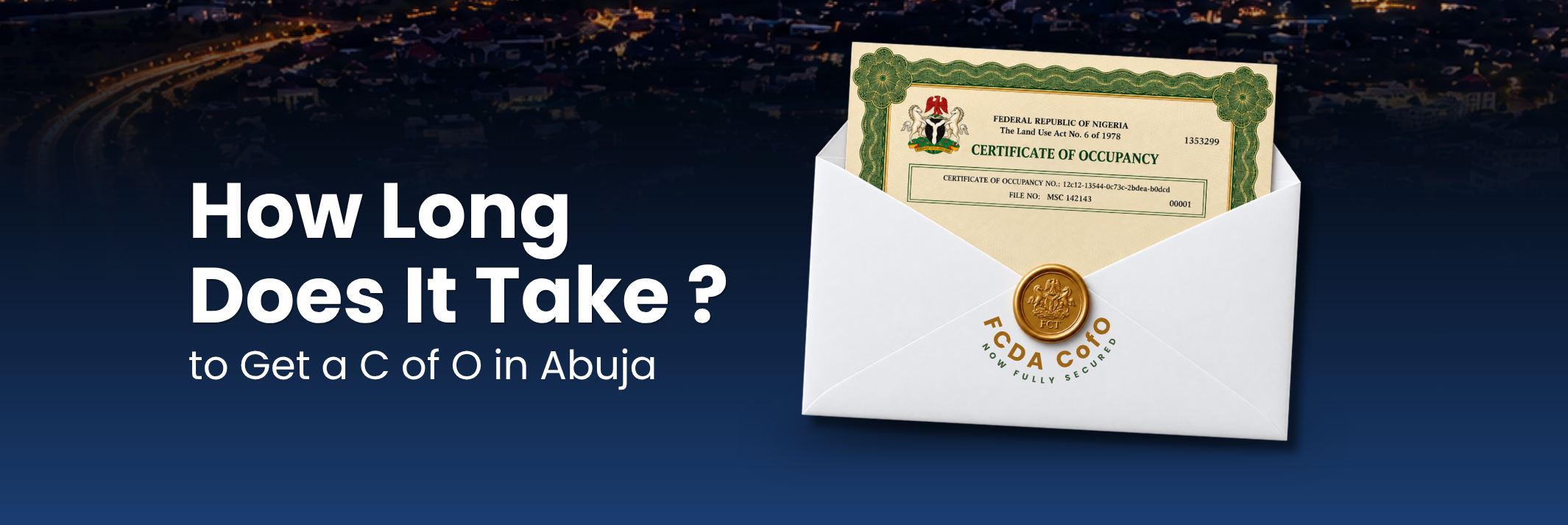
How Long Does It Take to Get a C of O in Abuja? A Complete Guide for Property Buyers

Buying land or property in Abuja comes with an important question: how long does it take to get a Certificate of Occupancy (C of O)?

For many property buyers and investors, the C of O is one of the most important documents associated with land ownership in Abuja. It provides evidence of a recognized interest in land and forms an important part of the property documentation process.

For the property documentation process being discussed here, the process can be broken into two key stages:

Stage 1: Filing and Payment — Approximately 14 Days

The initial filing and payment process takes approximately 14 days.

During this stage, the necessary documentation and applicable payments are processed to initiate the C of O application.

Stage 2: Securing the Full C of O Title — Approximately 3 Months

After the filing and payment stage, the process moves toward securing the full Certificate of Occupancy title, which takes approximately 3 months.

In this guide, we explain how the C of O process works in Abuja, what can affect the timeline, what documents are required and what you should check before buying land.

What Is a C of O?

A Certificate of Occupancy (C of O) is an official land title document issued by the relevant government authority to evidence a person’s or organization’s right of occupancy over a particular piece of land.

In the Federal Capital Territory, the Abuja Geographic Information Systems (AGIS) is responsible for the preparation and issuance of Certificates of Occupancy and other title documents. AGIS also provides property search and land-record verification services.

The Federal Capital Territory Administration’s Department of Land Administration is also responsible for the administration and management of land in the FCT, including the preparation and issuance of Certificates of Occupancy and Rights of Occupancy.

This is why proper title verification is so important when buying land in Abuja.


How Long Does It Take to Get a C of O in Abuja?

This means that buyers should understand that obtaining a C of O is not an overnight process. There are stages involved, and each stage needs to be properly completed before the final title is secured.

In simple terms:

14 days → Filing & Payment

Approximately 3 months → Securing the Full C of O Title

However, timelines can vary depending on the property’s documentation, the specific application, verification requirements and whether additional information or documentation is required.

For this reason, buyers should always ask their real estate company or relevant professionals to explain the specific documentation timeline attached to the property they are purchasing.


Why Does the C of O Process Take Time?

AGIS specifically notes that its release officer may request additional documents, information or further confirmation where necessary. It also advises applicants to comply fully with the stated requirements to avoid delays or refusal of collection.

Therefore, if someone tells you that “every C of O in Abuja takes exactly 30 days” or “every C of O takes exactly 90 days,” you should be cautious.

The more accurate answer is:

The time required to obtain a C of O in Abuja varies depending on the application and the status of the property’s documentation.


Why Does Getting a C of O Take Time?

A Certificate of Occupancy is not simply a document that is printed immediately after buying a piece of land.

The title has to go through the relevant administrative and documentation processes.

Several factors can affect the timeline.

1. The Status of the Property

The first thing to understand is that not every property starts from the same position.

A property may already have an existing title, may be undergoing title regularization, or may be part of a fresh allocation process.

The documentation required can therefore differ depending on the property’s history.

This is one reason why buyers should ask:

“What title does this property currently have?”

rather than simply asking:

“Does it have a C of O?”


2. Incomplete Documentation

Missing or incorrect documents can delay the process.

AGIS publishes specific requirements for C of O collection. These include the original acknowledgment/Right of Occupancy, evidence of ground-rent payment, payment of the C of O bill where applicable and payment of the title-regularization bill where applicable.

For companies, additional documents may be required, including particulars of directors and the company’s Certificate of Incorporation.

This is why buyers should ensure that all required documentation is properly prepared before beginning the process.


3. Outstanding Payments

Outstanding government charges can also affect the completion of a title process.

AGIS’s published C of O requirements include payment of ground rent and, where applicable, C of O and title regularization bills.

A buyer should therefore establish whether there are outstanding obligations attached to the property before committing funds.


4. Title Verification

Property verification is an important part of buying land in Abuja.

AGIS identifies property search and verification of land records as one of its official services.

A proper search can help establish what information is contained in the official land records and whether the documentation presented to a prospective buyer corresponds with those records.

This is particularly important when purchasing land from a third party.


5. Additional Information or Confirmation

Some applications may require additional documentation or confirmation.

AGIS states that its release officer reserves the right to request additional documents, information or further confirmations where necessary.

This means that two applications submitted at different times may not necessarily follow identical timelines.


What Documents Are Needed for a C of O in Abuja?

The exact requirements depend on the nature of the transaction and the application, but AGIS’s published requirements for C of O collection include:

  • Original acknowledgment/Right of Occupancy
  • Evidence of payment of ground rent
  • Payment of the C of O bill where applicable
  • Payment of title regularization bill where applicable
  • Letter of authority and identification where collection is through a proxy
  • Power of Attorney where applicable

For limited liability companies, AGIS also lists documents such as:

  • Form C07
  • Certificate of Incorporation
  • Identification of directors
  • Identification of the collector

These requirements are subject to the circumstances of the application, and AGIS may request additional documentation where necessary.


What Is the Difference Between a C of O and a Right of Occupancy?

This is one of the most common areas of confusion among property buyers in Abuja.

A Certificate of Occupancy and a Right of Occupancy (R of O) are not simply two different names for the same document.

AGIS separately identifies the preparation and issuance of Certificates of Occupancy and Rights of Occupancy among its land administration services.

When considering a property, therefore, don’t rely solely on statements such as:

“The land is fully documented.”

Ask for the specific documentation and have the title properly verified.


Can You Buy Land in Abuja Without a C of O?

Yes, it is possible to encounter land or property in Abuja that does not yet have a C of O.

However, the absence of a C of O does not automatically mean that a property is fraudulent, just as the presence of a document presented as a C of O should not eliminate the need for proper verification.

What matters is understanding the property’s title position.

Before purchasing, you should establish:

  • Who legally holds the interest in the property?
  • What documentation currently exists?
  • Is the documentation genuine?
  • Can the title be verified?
  • Are there outstanding government obligations?
  • Is there any issue affecting the property?
  • What steps remain before the title can be perfected?

This is where professional due diligence becomes important.


How Do You Verify Land in Abuja?

One of the most important steps before buying land is conducting a proper title search.

AGIS provides property search and verification of land records as part of its official services.

A buyer should not rely solely on:

  • A seller’s verbal assurance
  • A photocopy of a document
  • A receipt
  • A survey plan alone
  • A social media advertisement
  • A recommendation from a friend
  • The fact that other people have already bought in the area

Property documentation should be independently verified.


7 Things to Check Before Buying Land in Abuja

1. Verify the Title

Find out exactly what title exists over the property.

Don’t simply accept the phrase “C of O available.”

Ask to see the relevant documentation and have it verified.

2. Confirm the Survey

The property’s survey information should correspond with the land being offered to you.

3. Conduct a Property Search

Where appropriate, conduct an official search to establish the property’s record.

AGIS provides land-record search and verification services.

4. Check for Outstanding Obligations

Find out whether there are outstanding ground rents, title regularization payments or other relevant charges.

5. Understand the Property’s History

Ask how the seller acquired the property and what documentation supports the transaction.

6. Confirm the Seller’s Authority

Make sure the person or organization selling the property has the legal authority to transfer the interest being offered.

7. Work With Professionals

Property transactions involve legal, survey and documentation considerations.

For significant property purchases, professional due diligence can help identify issues before money changes hands.


Does a Property Need a C of O Before You Buy It?

Not necessarily.

This is an important distinction.

A property can have a legitimate title position even where the final C of O documentation has not yet been collected.

The critical question is not simply:

“Does it have a C of O?”

The better question is:

“What is the property’s current title status, and has that title been properly verified?”

For a buyer, understanding this distinction can prevent unnecessary confusion and help you evaluate property opportunities more intelligently.


How Long Should You Wait Before Following Up on Your C of O?

Because there is no single publicly stated processing timeline that applies to every C of O application, follow-up should be based on the status of the particular application rather than an assumed deadline.

If your application has been submitted and you believe it is taking longer than expected, confirm:

  1. Whether all required documents were submitted.
  2. Whether all relevant payments have been made.
  3. Whether any additional documentation has been requested.
  4. Whether there are outstanding issues with the title.
  5. The current status of the application through the appropriate official channel.

AGIS provides customer-service channels for complaints and inquiries regarding its services.


What Should You Ask a Real Estate Company Before Buying Land?

If you are considering buying land in Abuja, don’t be afraid to ask detailed questions.

A credible property company should be able to explain:

1. What is the title on the property?

2. Who owns the land?

3. Where can the title be verified?

4. What documentation will I receive after purchase?

5. Are there outstanding government charges?

6. What documentation process is required after purchase?

7. What is the expected documentation timeline based on the current status of the property?

These questions can give you a much clearer picture than simply asking for the price per square metre.


Final Thoughts: How Long Does It Take to Get a C of O in Abuja?

So, how long does it take to get a C of O in Abuja?

The honest answer is that there is no single guaranteed timeline for every application.

The process can be affected by the property’s title status, documentation, payments, verification requirements and whether additional information or confirmation is required.

For buyers, the bigger lesson is this:

Don’t buy property simply because someone tells you it has a C of O. Understand the title, verify the documentation and conduct proper due diligence before committing your money.

At NeoHomes, we believe that buying property should give you more than ownership—it should give you confidence in what you own.

Peace Beyond Shelter.

If you’re considering buying land or property in Abuja and want to understand the documentation, title position and investment potential before making a decision, speak with the NeoHomes team.

Your next property investment deserves proper due diligence.


Frequently Asked Questions

How long does it take to get a C of O in Abuja?

There is no universal processing period that applies to every C of O application in Abuja. The timeline can vary depending on the property’s documentation, title status, payments, verification and any additional requirements.

How much does a C of O cost in Abuja?

There is no single flat C of O cost applicable to every property. Applicable charges depend on the circumstances of the property and transaction. Buyers should obtain the relevant official bills rather than relying on an unofficial fixed amount.

Can I buy land without a C of O in Abuja?

Yes, properties can be offered with other forms of title or documentation. However, buyers should establish and independently verify the property’s exact title position before purchasing.

Is a Right of Occupancy the same as a C of O?

No. AGIS treats Rights of Occupancy and Certificates of Occupancy as distinct title documents and services.

How can I verify land in Abuja?

AGIS provides property search and verification of land records. Buyers should conduct appropriate title and property due diligence before completing a transaction.

What can delay a C of O in Abuja?

Incomplete documentation, outstanding payments, title regularization requirements, verification issues and requests for additional information can affect the process.

Where is the C of O processed in Abuja?

The relevant land administration and title services are handled through the FCT’s land administration system, including AGIS. AGIS is located at Plot 1, Kapital Street, Area 11, Garki, Abuja.



 

Click edit button to change this text. Lorem ipsum dolor sit amet, consectetur adipiscing elit. Ut elit tellus, luctus nec ullamcorper mattis, pulvinar dapibus leo.

CategoriesUncategorized

You Found Cheap Land in Abuja? Congratulations. Now Ask These 7 Questions

Finding cheap land in Abuja can feel like winning a small lottery.

You see a plot advertised at a price significantly below what you’ve seen in more established parts of the city. The location looks promising. The seller says the price is a limited-time offer. Perhaps you’ve even been told, “Buy now before the price increases.”

It is tempting to pay immediately.

But before you celebrate your bargain, pause.

Cheap land is only a good deal when you understand why it is cheap.

Abuja’s property market is diverse. Land prices can vary considerably depending on location, accessibility, infrastructure, title status, development potential and demand. A low price can represent a genuine early-stage investment opportunity, but it can also come with documentation, access, planning or other issues that you need to understand before committing your money.

So, if you’ve found what looks like cheap land for sale in Abuja, don’t just ask:

“How much is the land?”

Ask these 7 questions first.


1. What Exactly Is the Title on the Land?

This should be your first question.

Don’t stop at:

“The land is genuine.”

Ask:

“What is the title on the property, and can I verify it?”

Land in Abuja can have different forms of documentation and title. Depending on the property, you may encounter documents such as a Certificate of Occupancy, Right of Occupancy, allocation documents, survey documentation and other relevant title or transaction documents.

The important thing is to understand exactly what you’re buying and what documentation supports the seller’s interest in the property.

The Abuja Geographic Information Systems (AGIS) provides property search and verification of land records in the Federal Capital Territory.

This matters because a cheap price means very little if you cannot establish the legitimacy and status of the property.

Ask the seller:

  • What is the current title?
  • Who is the registered owner?
  • Can I conduct an official search?
  • Are there outstanding title obligations?
  • What documentation will I receive after purchase?

Never confuse a low price with a low-risk investment.


2. Why Is the Land So Cheap?

This is perhaps the most important question on the list.

If similar properties in comparable locations are selling for ₦20 million and someone is offering you land for ₦7 million, don’t immediately conclude that you’ve found the deal of the year.

Ask:

“Why is this land cheaper?”

There could be a perfectly reasonable explanation.

Perhaps the area is still developing.

Perhaps infrastructure has not yet caught up with the surrounding districts.

Perhaps the estate is offering an early-stage price to attract investors.

Perhaps the land is farther from the city centre.

All of these can create legitimate price differences.

But you should also investigate whether the low price is connected to:

  • Documentation issues
  • Poor accessibility
  • Planning restrictions
  • Disputed ownership
  • Outstanding obligations
  • Lack of infrastructure
  • Flood-prone terrain
  • Difficult topography
  • Encumbrances
  • An unclear transfer process

The objective isn’t to avoid cheap land.

The objective is to understand the reason behind the price.


3. Where Exactly Is the Land?

“It’s in Abuja” is not a location.

Abuja is a large and rapidly developing Federal Capital Territory with very different neighborhoods, districts and emerging growth corridors.

A property can be marketed as being “close to” a major district while being considerably farther away than a buyer initially assumes.

That’s why you should ask for the exact location, not just the general area.

Ask:

  • What district is the property in?
  • What is the exact location?
  • What roads provide access?
  • How far is it from major roads?
  • What developments are nearby?
  • What is the area’s development status?

Then, most importantly:

Go and see it.

A Google Maps pin, brochure or WhatsApp location is not a substitute for physically inspecting the property.


4. What Is the Road Access Like Today?

This question deserves its own section because access can significantly influence land value.

A property may be advertised as:

“Just 10 minutes from a major road.”

But what does that journey look like?

Is the road tarred?

Is it accessible during the rainy season?

Is there a properly established access road?

Can a normal vehicle reach the property?

Will infrastructure eventually improve the area?

And who is responsible for providing or maintaining the access infrastructure?

Don’t only ask what the road will look like in the future.

Ask:

“What does access look like today?”

Future infrastructure can contribute to appreciation, but your investment should still make sense based on the property’s current fundamentals.


5. What Infrastructure Is Already Available?

Cheap land can sometimes be cheap because the surrounding infrastructure is still developing.

That isn’t necessarily bad.

In fact, early-stage infrastructure development can create opportunities for investors who are willing to take a longer-term view.

But you need to know what you’re buying into.

Ask whether the area currently has:

  • Good road access
  • Electricity
  • Water
  • Drainage
  • Security
  • Perimeter fencing, where applicable
  • Nearby commercial activity
  • Schools or healthcare facilities
  • Residential development

Then ask a second question:

“What infrastructure is actually planned, and what is merely being promised?”

There is a significant difference.

A salesperson saying “a major road is coming soon” is not the same as having credible information about an approved or funded infrastructure project.


6. What Is the Land’s Development Potential?

You aren’t buying land simply because it is cheap.

You’re buying it because of what you believe that land can become.

This is where you need to think like an investor.

Ask:

“What can this land realistically become?”

Consider:

Location

Is the property positioned within a growth corridor?

Accessibility

Can people easily get to the property?

Surrounding development

Are homes, commercial developments and infrastructure already moving toward the area?

Demand

Who is likely to want this property in five or ten years?

Land use

Is the intended use compatible with the relevant planning requirements?

Future liquidity

If you eventually want to sell, will there be a market for the property?

A ₦5 million plot that nobody wants in ten years may be less attractive than a ₦10 million plot in an area with stronger fundamentals.

Price is what you pay. Potential is what you’re buying.


7. What Will I Pay After the Land Price?

This is the question many first-time buyers forget.

They see:

Land: ₦8 million

and assume they need ₦8 million.

Not necessarily.

Depending on the transaction and property, you may encounter additional costs associated with documentation, legal services, survey, registration, development or other applicable charges.

So ask for a complete cost breakdown before making payment.

Ask:

“What is the total amount I will spend from purchase to receiving the relevant documentation?”

This helps you distinguish between the advertised price and your actual acquisition cost.

A property advertised at ₦8 million may have a different total acquisition cost once applicable fees and documentation expenses are included.

Knowing the full cost upfront allows you to compare properties properly.


Bonus Question: Can I Bring My Own Lawyer to Review the Documents?

You absolutely should be comfortable asking this.

A property purchase is a significant financial commitment.

If you’re unsure about the documentation, consider engaging a qualified property lawyer to review the transaction and relevant documents before you pay.

Don’t let anyone pressure you with:

“You have to pay today or the land will be gone.”

Legitimate opportunities can have deadlines, but pressure should never replace due diligence.

If the seller refuses reasonable verification or becomes uncomfortable when you ask for documentation, consider that a warning sign.


Cheap Land vs. Good Land: What’s the Difference?

This is where many buyers get caught.

Cheap land is simply land offered at a low price.

Good land is land whose price makes sense relative to its location, title, accessibility, development potential, demand and other fundamentals.

The best investment isn’t necessarily the cheapest plot you can find.

It may be the property where the:

Price + Documentation + Location + Infrastructure + Demand + Growth Potential

create a compelling investment case.

That’s the difference between buying cheap and buying intelligently.


Should You Buy Cheap Land in Abuja?

Yes—if the fundamentals make sense.

Abuja continues to expand, and emerging locations can present opportunities for buyers who understand development patterns and are prepared to invest with a suitable time horizon.

But don’t make the mistake of assuming that every undeveloped location will automatically become the next major district.

Before buying, investigate.

Verify.

Inspect.

Ask questions.

And understand your investment objective.

Are you buying to:

  • Build immediately?
  • Hold for appreciation?
  • Build a family home?
  • Resell?
  • Generate rental income eventually?
  • Diversify your investment portfolio?

Your objective should influence the type of property you buy.


The 7 Questions to Ask Before Buying Cheap Land in Abuja

Let’s recap.

Before you pay for that seemingly irresistible piece of land, ask:

1. What exactly is the title on the land?

2. Why is the land so cheap?

3. Where exactly is the land?

4. What is the road access like today?

5. What infrastructure is already available?

6. What is the land’s development potential?

7. What will I pay after the land price?

And if possible, add an eighth:

8. Can my lawyer independently review the transaction?

If you cannot get satisfactory answers, don’t rush the purchase.


Final Thoughts

Finding affordable land in Abuja can be an exciting opportunity.

But don’t let the word “cheap” make the decision for you.

A smart property investor doesn’t ask only:

“How much can I buy this land for?”

They ask:

“What am I actually buying?”

The difference may seem small, but it can have a significant impact on the value and security of your investment.

Before committing your money, understand the title, inspect the location, assess the infrastructure, investigate the development potential and calculate the true acquisition cost.

Because in real estate, the cheapest property isn’t always the best deal.

The best deal is the one you understand.

At NeoHomes, we believe property ownership should come with confidence—not uncertainty.

If you’re considering buying land in Abuja and want to understand your options before making a decision, speak with the NeoHomes team.

NeoHomes — Peace Beyond Shelter.


Frequently Asked Questions

What is the cheapest area to buy land in Abuja?

Land prices vary significantly across Abuja and the wider FCT. Emerging districts and developing corridors may offer lower entry prices than established locations, but buyers should evaluate title, accessibility, infrastructure, demand and development potential before choosing a location based on price alone.

Is cheap land in Abuja a good investment?

It can be, but affordability alone does not make land a good investment. Buyers should assess the property’s title, location, accessibility, infrastructure, development potential and likely future demand.

How do I verify land before buying in Abuja?

Property buyers can conduct appropriate title and land-record searches through the relevant authorities. AGIS provides property search and verification services for land records in the FCT.

What documents should I ask for when buying land in Abuja?

The appropriate documents depend on the property’s title and transaction. Buyers should request the relevant title documents and supporting transaction documentation and have them properly reviewed and verified.

Should I buy land without seeing it physically?

It is strongly advisable to inspect the property or have a trusted professional conduct an inspection on your behalf. Physical inspection can reveal issues with access, terrain, drainage, surrounding development and location that may not be obvious from photographs or online listings.

What should I consider besides the price of land?

Consider title and documentation, location, accessibility, infrastructure, land use, surrounding development, demand, future growth potential and all additional acquisition costs.


CategoriesUncategorized

The Embassy, Apo-Wasa Abuja: The New Face of Modern Estate Living

For a long time, buying property in Abuja was largely about one thing: location.

Find a good district. Secure your land. Build your house.

But Abuja is changing, and so are the expectations of the people buying property in the city.

Today’s homeowners are looking for more than a good address. They want convenience. They want recreation. They want spaces for their children. They want access to everyday essentials. They want proper infrastructure. And increasingly, they want communities that make everyday life easier.

This shift is becoming particularly interesting in Apo-Wasa, one of the areas attracting increasing residential and development activity within the Federal Capital Territory.

And within this emerging residential landscape is The Embassy , a modern estate listed by NeoHomes Limited, designed around a simple but increasingly important idea:

What if your estate could offer more of the lifestyle you want, without requiring you to leave the community?

Apo-Wasa Is Becoming Part of Abuja’s Growth Story

Abuja has always been a city of expansion.

As established districts mature, new corridors gradually attract developers, homeowners and investors looking for the next opportunity.

Apo-Wasa is increasingly becoming part of that story.

The area is seeing active property development, with residential and mixed-use land being marketed across the corridor. More significantly, in June 2026, the Federal Government Staff Housing Loans Board announced that approval had been granted to begin arrangements for a proposed housing estate in Apo-Wasa.

This kind of activity is worth watching.

It does not  just mean every property in the area will automatically become a good investment. But it reinforces a larger point:

Apo-Wasa is becoming an increasingly relevant part of Abuja’s expanding residential market.

And this is where developments such as The Embassy become particularly interesting.

Introducing The Embassy

The Embassy, Apo-Wasa, Abuja is a modern residential estate listed by NeoHomes Limited, created around a more contemporary approach to community living.

Rather than treating amenities and infrastructure as afterthoughts, The Embassy brings several lifestyle conveniences and essential infrastructure into the estate itself.

The development is planned to feature:

  • EV charging station

  • Indoor gym

  • Supermarket

  • Children’s playground

  • Sports courts

  • Dedicated access road and internal connectivity

That combination speaks to a different kind of homebuyer.

Someone who isn’t simply asking:

“How much is the property?”

But also:

“What kind of life can I have here?”

Connected by Access, Designed for Convenience

One of the practical considerations when buying property in an emerging area is accessibility.

An attractive estate means little if getting to and from it is unnecessarily difficult.

The Embassy addresses this with an access road connecting the estate and its surrounding routes, providing a defined connection into the development.

For residents, accessibility isn’t merely a convenience.

It affects everyday life.

It affects how easily residents can get to work, school, shopping, appointments and other parts of Abuja.

It can also influence how an emerging neighbourhood develops over time.

This is why access and internal connectivity should be considered alongside amenities when evaluating a new residential development.

Ownership Begins With Documentation

Location and amenities may attract attention, but serious property buyers eventually come back to one fundamental question:

What is the documentation?

For The Embassy, the development’s FCDA Certificate of Occupancy (C of O) has been paid in full.

That is an important part of the property’s ownership story.

For prospective buyers, proper documentation is not a minor detail to be considered after choosing a property. It is one of the fundamental aspects of real estate due diligence.

The FCDA C of O position gives buyers an important point to consider when evaluating the development, alongside other factors such as the property’s specific allocation, transaction documentation, development terms and the buyer’s intended use.

In other words, The Embassy isn’t being positioned around amenities alone.

The infrastructure, accessibility and documentation matter too

Beyond Four Walls

There is an important distinction between owning a house and owning a home within a community.

A building can give you shelter.

A well-designed community can give you an environment.

The Embassy is designed with this broader concept of living in mind, The EV station, the sports clubs, the indoor gym and supermarkets.

Individually, these may look like amenities and infrastructure.

Together, they tell a much bigger story:

The estate is being designed around the people who will live there.


Why The Embassy Stands Out

The Embassy’s strongest proposition isn’t any single amenity.

It is the combination.

An indoor gym on its own is useful.

A supermarket on its own is convenient.

A playground on its own is valuable to families.

Sports courts on their own provide recreation.

An EV charging station on its own provides a modern mobility solution.

An access road on its own provides connectivity.

And proper documentation provides an important foundation for ownership.

But bringing these elements together within one residential community creates something different.

It creates an estate where living, accessibility, convenience and lifestyle are considered together.

NeoHomes: Bringing The Embassy to Property Buyers

For buyers searching for property opportunities in Abuja, finding the right development is only one part of the process.

The other part is finding a real estate company that can properly guide them through the opportunity.

NeoHomes Limited currently has The Embassy, Apo-Wasa among its property listings, giving prospective buyers an opportunity to explore the development and understand what it offers.

For NeoHomes, the listing represents an opportunity to connect buyers with a development that combines lifestyle amenities with accessibility and a defined documentation position.

Prospective buyers can learn more about the available property options, documentation, payment structure and inspection opportunities through NeoHomes.


The Bigger Story: Where Is Abuja Going Next?

Perhaps the most interesting thing about The Embassy isn’t simply the estate itself.

It is what developments like it tell us about where Abuja’s real estate market may be heading.

The next generation of residential developments may not compete solely on land size or location.

They may compete on experience.

The communities that offer residents convenience, recreation, accessibility, infrastructure and a sense of belonging could become increasingly attractive as Abuja continues to grow.

And Apo-Wasa provides an interesting backdrop for that evolution.

With increasing property activity and new housing initiatives emerging in the broader area, the corridor is becoming one to watch.

The Embassy: A Different Idea of Home

A home should give you somewhere to live.

But what if it could give you somewhere to live well?

That is the idea behind The Embassy.

A residential community where the gym is closer.

Where the supermarket is within the estate.

Where children have somewhere to play.

Where sports are part of the community.

Where electric vehicle charging infrastructure is part of the development concept.

Where access is planned for easier movement.

And where the FCDA C of O has been paid in full, giving the development a significant documentation milestone.

The Embassy, Apo-Wasa Abuja, is not simply about owning property.

It is about being part of a different idea of residential living.

Discover The Embassy with NeoHomes

If you are considering buying property in Apo-Wasa or exploring emerging residential opportunities in Abuja, The Embassy is a development worth putting on your radar.

Listed by NeoHomes Limited, The Embassy brings together lifestyle amenities, accessibility and a defined documentation position in one emerging Abuja location.

The future of Abuja living is being shaped by communities that understand that a home is more than four walls.

The Embassy is one of them.

CategoriesUncategorized

NeoHomes Limited Named Emerging Sites and Services Company of the year at Abuja Real Estate Award


NeoHomes Limited has been named Emerging Sites and Services Company of the Year at the Abuja Real Estate Awards (ARE Awards) 2.0, held during the Abuja Real Estate Fireside Chat 3.0.

The award recognise organisation that have demonstrated measurable growth, operational excellence, and sustained commitment to quality within Nigeria’s expanding property sector. For NeoHomes, it represents formal industry acknowledgement of a trajectory built steadily over three years.
Since its founding, the company has sold over 450 plots across a portfolio of more than 16 residential and investment developments, serving over 300 investors and homeowners in two of Nigeria’s most active real estate markets.
Speaking on the recognition, Mr. Chukwuemeka Obiazkwor, Chief Executive Officer of NeoHomes Limited, situated the award within the broader challenge facing Nigeria’s property sector.
“Nigeria’s housing gap is not simply a supply problem. It is a trust problem. What we have been building at NeoHomes is not just property. We have been building the confidence that Nigerians deserve to feel when they invest in land and real estate. This recognition tells us the market is beginning to reward companies that treat integrity as infrastructure.”
NeoHomes’ portfolio includes Palmera Residence, Crest Mark Estate, Eco View Estate, Solaris Estate, Neo Summit, Neoclassic Estate, Belle Vista Apartments, Heartland City, D’Max Estate, and several other developments strategically located across Abuja and Asaba. The company’s stated philosophy, delivering what it describes as “Peace Beyond Shelter,” has guided its approach to both development and client relations since inception.
Industry observers have consistently identified transparency, infrastructure quality, and long term planning as the foundations of sustainable real estate growth in Nigeria. NeoHomes has aligned its operational model with these priorities, focusing on accessible land ownership within key urban growth corridors.
The ARE Award 2.0 marks a significant milestone in the company’s short history. Its leadership, however, has indicated that the recognition is the beginning of a larger ambition to shape the future of property development in Nigeria.
Categoriestips & tricks Uncategorized

Maitama vs Asokoro vs Apo/Wasa: Where to Invest in Abuja Real Estate

Same City, Different Entry Point: Maitama, Asokoro & Apo/Wasa Compared

Abuja is one city, but the cost of entering its real estate market can change dramatically depending on where you invest.

If you wanted landed property in Maitama, you could be looking at prices around ₦2 million per square metre — roughly ₦185,800 per square foot. In Asokoro, prices can sit closer to ₦700,000 per square metre, or approximately ₦65,000–₦70,000 per square foot.

Move further towards Apo/Wasa, however, and land can be available within the region of ₦37,000–₦45,000 per square metre, depending on the property, title, location and development.

Same Abuja. Completely different entry points.

For investors looking for land for sale in Abuja, understanding why this pricing gap exists is more important than simply comparing the numbers.

.


Why Invest in Abuja Real Estate?

Abuja has a structural advantage that distinguishes its property market from many other Nigerian cities: land administration within the Federal Capital Territory is centrally regulated.

Land documentation and allocation are overseen through FCT institutions, while Abuja Geographic Information Systems (AGIS) plays an important role in land records and title verification.

For investors, this makes proper due diligence critical — but also provides a formal framework through which land ownership claims can be investigated before purchase.

Abuja also benefits from a distinctive demand base.

As Nigeria’s capital, the city accommodates federal government institutions, embassies, diplomatic missions, international organisations, businesses and a growing professional population.

This creates demand for residential and commercial property that extends beyond short-term speculation.

The question, therefore, isn’t simply whether Abuja has investment potential.

It is where in Abuja you enter the market — and at what stage of development.

Maitama & Asokoro: Abuja’s Established Core

Maitama and Asokoro represent some of Abuja’s most established and prestigious districts.

They benefit from mature road networks, developed infrastructure and decades of diplomatic, governmental and high-income residential activity.

For property investors, that maturity provides an obvious advantage: much of the infrastructure required to support premium property values is already in place.

But there is a trade-off.

You are paying for that maturity.

Land prices in Maitama and Asokoro already reflect their infrastructure, scarcity, prestige and established demand. This makes both districts attractive for wealth preservation and premium property ownership, but creates a significantly higher barrier to entry.

For an investor seeking an earlier-stage opportunity, the economics are different.

That brings us to Apo/Wasa.

Apo/Wasa: Abuja’s Emerging Investment Corridor

Apo/Wasa represents a different stage in Abuja’s development cycle.

Rather than buying into a district where infrastructure and premium pricing are already firmly established, investors are entering a corridor that is still being built out.

Historically, early land within parts of the area could be acquired for only a few million naira per plot. Today, entry-level estate plots can command substantially higher prices, while larger residential and commercial plots are priced at further premiums.

The important question is:

What is driving the change?

Increasing attention around Apo Wasa real estate investment is closely tied to infrastructure development and improved connectivity within Abuja’s southern corridor.

1. Outer Southern Expressway (OSEX)

The Outer Southern Expressway (OSEX) is one of the major transport corridors influencing development around this axis.

As road infrastructure expands and previously less-accessible districts become better connected to established parts of Abuja, the investment proposition of surrounding land can change considerably.

For real estate investors, accessibility is one of the factors that can influence both development activity and long-term land values.

2. Apo–Karshi Road

The long-running Apo–Karshi road project is another important development for the corridor.

Improved connectivity along this route could make movement between Apo, surrounding districts and communities along the Karshi axis easier, potentially increasing residential and commercial activity.

For investors evaluating Apo Wasa land, the significance isn’t simply that another road is being constructed.

It is that multiple infrastructure projects are improving access to an area that historically sat outside Abuja’s most developed residential core.

3. Broader Development Around the Corridor

The proposed relocation and redevelopment of commercial activities, including plans associated with the Apo Mechanic Village, add another dimension to the area’s growth story.

Roads, housing, commercial activity and population movement tend to reinforce one another.

As accessibility improves, developers enter. As development increases, businesses and residents follow. And as demand for usable land increases, pricing can adjust accordingly.

That is the opportunity investors are watching in Apo/Wasa.

Infrastructure Can Change the Value of Location

Abuja’s expansion has repeatedly demonstrated one fundamental real estate principle:

Location matters, but accessibility can redefine location.

An area that feels distant when roads are incomplete can become significantly more attractive once major transport infrastructure connects it to employment centres, commercial districts and established neighbourhoods.

This is why investors often pay close attention to infrastructure before development is fully completed.

By the time every road is finished, every commercial centre is operating and every surrounding estate is occupied, much of the early-stage pricing advantage may already have disappeared.

Apo/Wasa currently sits somewhere between those two stages.

It is no longer simply a future-development story, but neither is it priced like Maitama or Asokoro.

That gap is what makes the corridor worth watching.

Is Apo/Wasa a Good Place to Buy Land?

Potentially — but infrastructure growth does not make every piece of land a good investment.

Apo/Wasa is already attracting developers, land-banking companies and individual investors. Property prices across the district can vary considerably depending on location, accessibility, title, estate development and plot size.

That creates opportunity, but it also makes due diligence essential.

Before buying land in Apo/Wasa — or anywhere else in Abuja — investors should independently verify the property.

What to Check Before Buying Land in Abuja

Verify the land through AGIS.
Do not rely solely on documents presented by an agent, developer or seller. Confirm the property’s records and status independently.

Understand the title being offered.
Determine exactly what legal interest or allocation documentation applies to the property rather than treating every land document as equivalent to a Certificate of Occupancy.

Check statutory obligations.
Confirm applicable ground rent, development levies and other statutory obligations associated with the property.

Confirm the exact location.
Two properties marketed as “Apo/Wasa” can have very different investment prospects depending on road access, surrounding development and their actual coordinates.

Investigate the developer or seller.
A promising location does not compensate for weak documentation or an unreliable counterparty.

In Abuja real estate, due diligence isn’t optional. It is part of the investment.

Maitama vs Asokoro vs Apo/Wasa: Which Makes More Sense?

There isn’t one answer for every investor.

Maitama offers prestige, scarcity and an established premium market — but at an exceptionally high entry price.

Asokoro provides many of the characteristics of Abuja’s established core, including mature infrastructure and strong institutional presence, while still commanding premium land values.

Apo/Wasa offers a considerably lower entry point and exposure to an emerging development corridor — but with greater need for careful title verification, location selection and patience.

The decision ultimately depends on what you are buying for.

If the priority is established prestige and wealth preservation, Maitama and Asokoro remain difficult to ignore.

If the objective is to identify a developing Abuja corridor before its infrastructure and property prices fully mature, Apo/Wasa presents a different proposition.

The Bottom Line

Maitama and Asokoro represent much of Abuja’s finished product.

Apo/Wasa represents part of the city that is still being built.

And that distinction matters.

Infrastructure, accessibility and urban expansion can transform how the market values land. Investors who enter developing corridors earlier may benefit from that transition, but only when the underlying property has the right documentation, location and development fundamentals.

For anyone considering real estate investment in Abuja, the opportunity isn’t simply about finding cheap land.

It is about finding the right entry point.

And right now, Apo/Wasa is one of the corridors worth watching as Abuja continues to expand.

Always verify land title and documentation independently before making a purchase. Property prices vary by location, title, plot size, seller and market conditions. This article is for informational purposes only and does not constitute financial, investment or legal advice.