
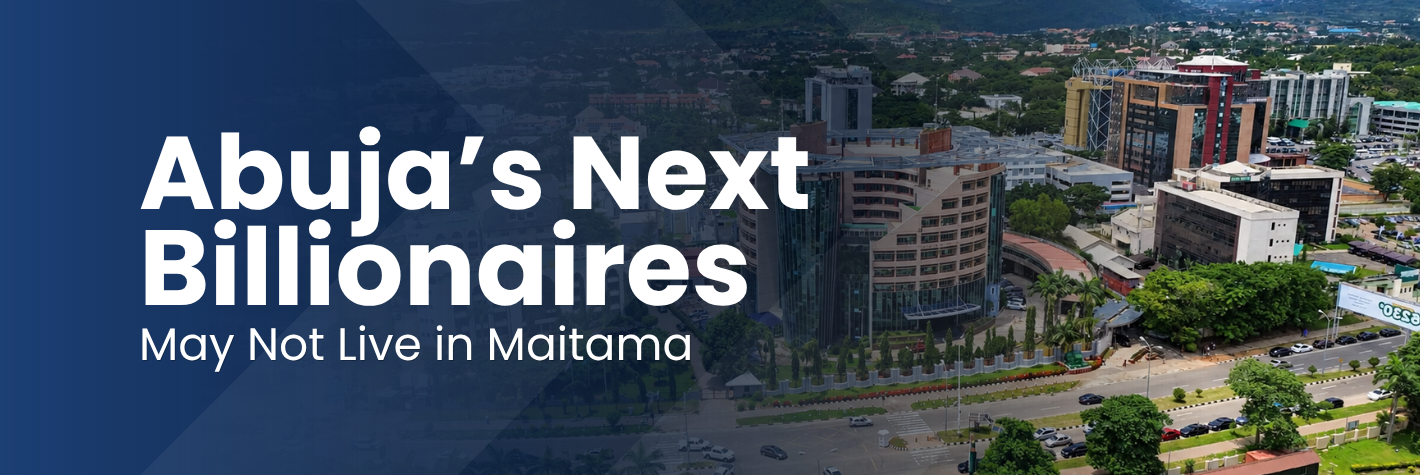
Abuja’s Next Billionaires May Not Live in Maitama
For decades, when people talked about wealth in Abuja, certain addresses immediately came to mind.
Maitama.
Asokoro.
Wuse 2.
These are established districts. They have premium properties, strong infrastructure, proximity to major institutions and some of the city’s highest property values.
But there is another side to Abuja’s real estate story.
What if the next generation of property wealth is created somewhere that does not look like Maitama today?
That is the question investors should be asking.
Because in a city that is still expanding, wealth is not created only by owning property in the most expensive neighbourhoods.
Sometimes, it is created by identifying where the city is going next.
And Abuja is going next in several directions.
Maitama Is Already Established. The Opportunity Is Somewhere Else.
There is nothing wrong with investing in Maitama.
In fact, established districts have advantages that emerging areas may take years to develop.
Maitama has infrastructure, established demand, premium housing and proximity to major parts of the city.
But there is a fundamental difference between buying into an established market and buying into an emerging one.
When you buy in an established location, you are often paying for the value that has already been created.
When you buy in an emerging location, you are potentially positioning yourself before the area reaches maturity.
That distinction is important.
A plot of land in a developing corridor may cost significantly less than property in a prime district, but it may also require more patience, stronger due diligence and a willingness to wait for infrastructure and demand to develop.
The opportunity is not that every developing area will become the next Maitama.
It is that some areas will grow significantly as Abuja expands.
Abuja Is Becoming Bigger Than Its Traditional Core
Abuja was planned as a city with a central core and satellite towns.
The FCDA’s planning framework includes satellite towns such as Kuje, Bwari, Karshi, Kubwa, Kusaki Yanga and Dobi, with infrastructure and linkages intended to connect these communities to the Federal Capital City.
That tells us something important.
The expansion of Abuja is not an accident.
The city was designed to grow beyond its original centre.
Today, that expansion is becoming increasingly visible.
Infrastructure is opening up previously less accessible locations, while developers are building housing and commercial projects around emerging corridors.
Recent reporting has identified areas including Karsana, Idu, Lugbe and Kuje among locations attracting increased development and investor attention as connectivity improves.
So when you think about Abuja’s real estate market, you should not only ask:
“Where is Abuja expensive today?”
You should also ask:
“Where is Abuja expanding?”
Real Estate Wealth Is Often About Timing
Consider two investors.
Investor A buys a property in an established district after the area has already become highly developed.
Investor B buys land in an emerging corridor when roads, businesses and housing are still developing around it.
They are making two very different investment decisions.
Investor A is buying certainty and established demand.
Investor B is buying potential and time.
Neither approach is automatically better.
But the second approach can create a different opportunity for investors who are willing to wait.
The challenge is identifying whether an area is genuinely developing or simply being marketed as “the next big thing.”
That is where research becomes important.
What Actually Turns an Emerging Area Into a Valuable One?
Not every undeveloped area becomes a property hotspot.
Empty land is not the same thing as future value.
For an emerging location to become more valuable, several things usually need to happen.
Infrastructure
Roads, drainage, electricity, water and other infrastructure can make previously difficult-to-reach areas more practical for residents and businesses.
Accessibility
A location becomes more attractive when people can move easily between it and important employment, commercial and residential centres.
Population Growth
More people create more demand for housing, shops, offices, schools, healthcare and other services.
Economic Activity
Businesses create jobs, customers and movement.
Development
When reputable developers begin building homes, estates, commercial centres and other facilities, it can be a sign that the market is becoming more active.
Demand
Ultimately, somebody has to want to live, work, shop or invest there.
Infrastructure alone does not create a property market.
Infrastructure + accessibility + people + economic activity + demand are much more meaningful.
Watch the Roads, Not Just the Buildings
If you want to understand where Abuja is heading, watch the infrastructure.
A new road can change how people perceive distance.
A new interchange can make a previously inconvenient location easier to reach.
Improved connectivity can make it possible for people to live farther from the city centre while still commuting to work.
This relationship between infrastructure and property is already visible across Abuja.
Recent property-market reporting has linked infrastructure development to increased activity in districts including Guzape, Katampe, Jahi, Karsana, Idu, Lugbe and Kuje.
But investors need to go one step further.
Do not simply ask:
“Is there a road project?”
Ask:
“What does the road connect?”
That is a much more useful question.
The Next Big Property Story May Be Along a Corridor
One neighbourhood does not necessarily create a property boom by itself.
Sometimes, growth happens along an entire corridor.
As accessibility improves, development can spread from one district into neighbouring areas.
You may begin with housing.
Then come shops.
Then schools.
Then offices.
Then hospitality.
Then larger residential developments.
Eventually, what used to be considered an “outskirts” becomes part of the city’s normal daily movement.
This is one reason investors should pay attention to growth corridors, rather than looking at individual locations in isolation.
Which Parts of Abuja Should Investors Watch?
There is no single list of locations that will automatically become Abuja’s next premium districts.
But several emerging and expanding corridors deserve attention because of their relationship with infrastructure, housing demand and urban expansion.
Ketti-Kabusa and the Southwest Corridor
Ketti-Kabusa sits within a part of Abuja where residential development and land investment continue to attract attention.
For investors, the important question is not simply whether land is affordable.
It is what is happening around the location.
What roads are being developed?
What communities are expanding?
What estates are coming up?
How accessible is the property?
And what type of demand could eventually emerge?
These questions matter more than simply buying because the price looks low.
Kuje
Kuje is one of the FCT’s designated satellite towns, and its connection to the broader Abuja development system makes it an area worth studying.
Its position along the southwest growth direction has also attracted increasing housing and investment activity.
But again, investors should avoid treating the entire area as one market.
A property close to good infrastructure can have a very different investment profile from another property several kilometres away.
Micro-location matters.
Karsana and the Northern Growth Belt
Karsana is another area that has increasingly entered Abuja’s property conversation.
Infrastructure improvements and residential development are helping shift attention toward several northern and northwestern districts.
For investors, the question is whether development is creating genuine demand rather than simply increasing speculative activity.
That distinction matters.
Kyami and the Airport Corridor
The Airport Road axis is increasingly being discussed as more than simply a route to Nnamdi Azikiwe International Airport.
Recent analysis of Abuja’s future growth has identified the Airport Road axis, Kuje and Kyami among areas that could develop stronger commercial and residential activity as the city becomes more polycentric.
For property investors, that creates an interesting dynamic.
When a corridor connects housing, transportation, commercial activity and major destinations, the land around it can become increasingly relevant.
But once again, potential is not a guarantee.
You Don’t Need to Buy in Maitama to Build a Property Portfolio
There is a psychological trap in real estate.
People often believe that expensive property equals better investment.
It is easy to understand why.
If a property in Maitama is worth hundreds of millions of naira, it feels more valuable than a plot in an emerging district.
But investment is not simply about the price of an asset.
It is about:
Entry price.
Demand.
Growth.
Time horizon.
Income potential.
Liquidity.
Risk.
A lower-priced property in a developing corridor may provide a different path to building a portfolio.
For example, an investor with ₦100 million may choose to purchase one expensive property in an established district.
Another investor may use the same capital differently, acquiring multiple assets at earlier stages of development.
The outcome will depend on the properties selected, their documentation, location, development trajectory and market conditions.
There is no guaranteed formula.
But the example illustrates an important principle:
You do not have to buy the most expensive property in Abuja to participate in Abuja’s growth.
The Billionaire Mindset Is Not About Buying Cheap Land
This is where the conversation needs some discipline.
“Buy cheap land and wait” is not an investment strategy by itself.
Cheap land can remain cheap.
Sometimes for years.
Sometimes permanently.
The real question is:
Why is the land cheap?
If the answer is that infrastructure is missing, demand is weak, the title is unclear or the location is poorly connected, a low price may simply reflect a high level of risk.
But if the price is relatively low because the area is still developing while infrastructure and economic activity are moving toward it, the situation becomes more interesting.
This is why sophisticated property investors do not simply hunt for cheap land.
They hunt for mispriced potential.
What Should You Look For Before Buying in an Emerging Area?
If you are considering an emerging Abuja location, examine at least these factors.
1. Title and Documentation
Before thinking about appreciation, establish that the property itself is properly documented.
2. Road Access
Do not rely on promises of future roads.
Look at what exists today and verify major projects that are expected to improve access.
3. Existing Development
Are reputable developers already building around the area?
4. Population
Are people actually moving into the area?
5. Commercial Activity
Are businesses following the residential development?
6. Infrastructure
Look beyond roads. Consider electricity, water, drainage, telecommunications and other essential services.
7. Demand
Who will eventually buy, rent or occupy the property?
8. Your Time Horizon
Emerging-location investments may require patience.
If you need immediate rental income, a developing corridor may not be the right fit.
Don’t Confuse Speculation With Growth
This is one of the most important lessons for investors.
An area can have plenty of land transactions without having a healthy real estate market.
Speculation happens when people buy simply because they expect someone else to pay more later.
Growth is different.
Growth happens when:
- People move in.
- Businesses open.
- Roads improve.
- Homes are built.
- Services become available.
- Economic activity increases.
- Demand becomes more sustainable.
You want to understand whether the area is experiencing real development, not just land flipping.
Abuja’s Future May Be Polycentric
There is another major shift investors should watch.
Abuja may increasingly function as a city with multiple economic and commercial centres rather than one dominant core.
A September 2026 analysis cited real estate expert Ijeomah, who argued that satellite communities could become increasingly integrated into Abuja’s everyday economy, with secondary commercial nodes developing around corridors such as Airport Road, Kubwa/Bwari, Kuje, Kyami and Apo/Karshi.
Whether every part of that projection materialises remains to be seen.
But the underlying idea is important:
A growing city does not necessarily keep all its economic activity in one centre.
As housing becomes more expensive in established districts and infrastructure improves elsewhere, businesses and residents can spread outward.
That creates new property markets.
The Question Investors Should Be Asking
Instead of asking:
“Is this the next Maitama?”
Ask:
“What is happening here that could make this location more valuable five or ten years from now?”
That question forces you to look at evidence.
You begin studying infrastructure.
You look at population.
You examine development.
You investigate title.
You compare prices.
You identify the people who will eventually demand the property.
And most importantly, you stop investing based solely on hype.
The Next Generation of Abuja Property Wealth
The next generation of wealthy property investors may not necessarily live in Maitama.
They may own properties in Maitama.
They may own properties in Asokoro.
But they may also own land, apartments, commercial property and development sites in locations that many people currently consider “far.”
Because the real advantage in a growing city is not always being in the most prestigious location.
Sometimes, it is being early enough to understand where the city is going.
Abuja is expanding.
The infrastructure network is changing.
New residential communities are emerging.
Commercial activity is spreading.
And satellite towns are becoming increasingly important to the capital’s long-term development framework.
That does not mean every emerging district will become a premium neighbourhood.
It means investors have more locations to study—and more opportunities to think beyond the traditional Abuja property map.
Investing Beyond the Traditional Abuja Address
At NeoHomes Limited, we believe real estate investment should not be driven by the prestige of an address alone.
It should be driven by understanding the location, the documentation, the infrastructure, the demand and the development story behind the property.
That is why our growing portfolio extends across different parts of Abuja, including Kyami, Kuje, Karsana, Kabusa and Ketti-Kabusa, among other emerging and established locations.
The goal is not to tell every investor that one particular district is “the next big thing.”
The goal is to help buyers identify opportunities that align with their budget, investment horizon and objectives.
Because Maitama may represent the Abuja that has already been built.
But the Abuja that is still being built may create a very different set of opportunities.
And sometimes, the most important address in real estate is not where the city is today.
It is where the city is going next.
NeoHomes Limited — Peace Beyond Shelter.