
What Does FCDA Approval Mean When Buying Land in Abuja?
When searching for land in Abuja, one phrase appears again and again: “FCDA approved.”
For many buyers, those two words are enough to create a sense of security. But an important question remains: what does FCDA approval actually tell you about a piece of land?
Does it mean you already have a Certificate of Occupancy? Does it prove ownership? Does it mean construction can begin immediately?
Not necessarily.
Understanding the difference between planning approval, land use, allocation and title documentation is an essential part of buying land in Abuja. The Federal Capital Development Authority (FCDA) was established to oversee the planning, development and administration of Abuja and the wider Federal Capital Territory, including planning the city and providing infrastructure in line with the Abuja Master Plan.
So before you hear “FCDA approved” and reach for your cheque book, here is what you should know.
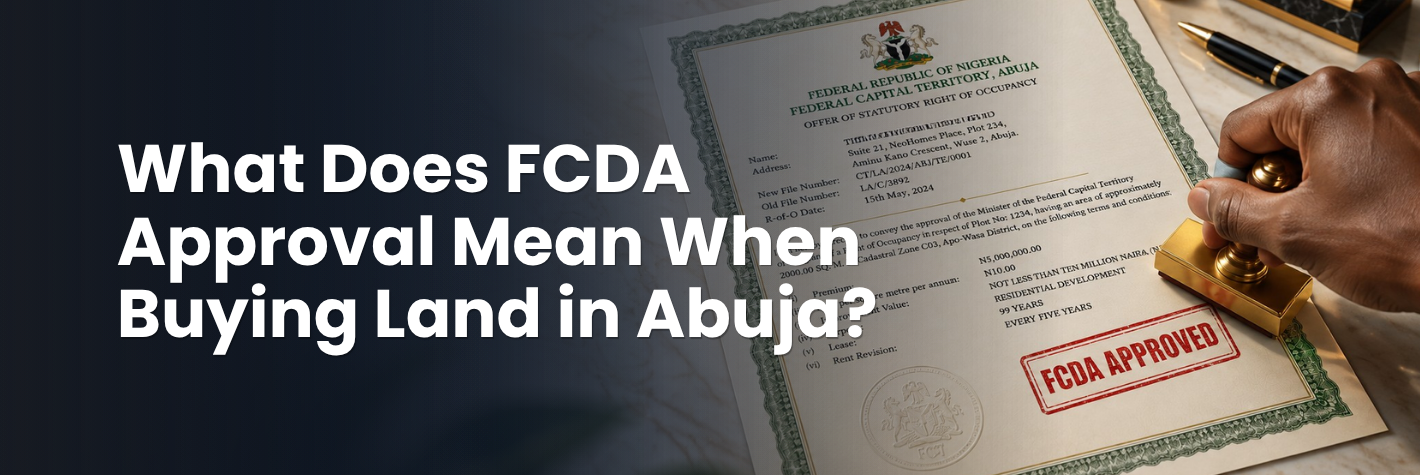
First, What Is the FCDA?
The Federal Capital Development Authority, commonly called the FCDA, was created after the establishment of the Federal Capital Territory in 1976. It was given responsibility for planning, designing and developing the new federal capital.
One of its important functions is overseeing physical planning and development within the FCT.
Its Department of Urban and Regional Planning is responsible for physical planning and development monitoring. Its responsibilities include preparing and monitoring development plans, evaluating development applications, and coordinating matters such as changes of land use, subdivisions and plot extensions.
This matters because Abuja was deliberately designed as a planned city. Land is therefore considered within a wider planning framework rather than simply as an empty parcel on which an owner can build anything.
So, What Does “FCDA Approved” Actually Mean?
The phrase “FCDA approved” is commonly used in property marketing to indicate that a layout, development or land-related proposal has received relevant planning approval or recognition.
However, buyers should not treat the phrase as a complete description of the property’s legal status.
An approval connected to a layout, subdivision, proposed development or land use is not necessarily the same thing as documentation establishing an individual’s legal interest in a particular plot.
That distinction is important.
Instead of simply asking a developer or seller, “Is this FCDA approved?”, ask:
What exactly was approved?
Which authority issued the approval?
What document proves the approval?
Does it cover this specific plot or the wider development?
What title and allocation documents accompany the property?
Those questions give you a much clearer understanding of what you are actually purchasing.
FCDA Approval and a C of O Are Not the Same Thing
This is one of the most important points for anyone buying land in Abuja.
An FCDA-related planning or development approval does not automatically mean that the property has a Certificate of Occupancy (C of O).
The two serve different purposes.
A simple way to understand the distinction is:
Planning and development approval: What can be done with the land, subject to the applicable planning framework?
Title documentation: What legal interest or rights does the holder have in the land?
They are connected, but one should not be treated as a substitute for the other.
That is why a buyer should never stop due diligence simply because a property has been described as “FCDA approved.”
Why Should Buyers Care About FCDA Approval?
Planning status can tell you something important about how a property fits into Abuja’s development framework.
The FCDA’s planning functions include preparing land-use plans and detailed site development plans and monitoring development against the city’s planning framework.
That can matter in several ways.
The Designated Use of the Land
A plot is not necessarily suitable for every possible purpose.
Land may be designated for residential, commercial, institutional, recreational or other uses.
If you purchase a property marketed as residential, for example, you should not assume that you can simply turn it into a commercial facility without obtaining the necessary approvals.
Development Restrictions
Abuja’s planned structure also includes areas reserved for roads, waterways, sewer lines and other infrastructure.
The FCDA has warned against encroachment into such areas and has advised developers to stay within the boundaries of their titles and allocations.
This is why a piece of land looking vacant on the ground does not, by itself, establish that it is available for development.
Relationship With the Master Plan
The FCDA states that its mission includes developing Abuja in compliance with the Abuja Master Plan.
For investors, understanding how a property fits into that broader planning structure can therefore be useful before committing funds.
Does FCDA Approval Automatically Make Land Safe to Buy?
No.
This is where buyers need to exercise caution.
Planning approval is only one part of property due diligence. You still need to investigate ownership, title, allocation, survey information, possible encumbrances and other obligations associated with the property.
The FCDA itself has separate functions covering planning, surveying and other aspects of land administration. Its survey functions include surveying parcels and layouts, working with cadastral zones and producing survey information used for Title Deed Plans.
So rather than asking only:
“Is this land FCDA approved?”
A better question is:
“What is the complete legal, planning and documentation status of this particular plot?”
That question is much harder to misunderstand.
What Documents Should a Buyer Request?
The exact documentation required depends on the nature and history of the property, but a buyer should expect the seller or developer to clearly explain the documents supporting the transaction.
Depending on the property, these may include documentation relating to:
- Allocation
- Survey
- Title
- Development or planning approval
- Land-use designation
- Deeds or other instruments establishing the relevant interest
- Evidence of applicable statutory payments
The goal is not simply to collect as many documents as possible.
The real objective is to understand what each document proves and whether all the documents tell the same story about the property.
For every important document, ask:
Who issued it?
What does it establish or approve?
Does it identify the specific property being sold?
Do the plot details correspond with the survey and other records?
Are there outstanding obligations attached to the property?
FCDA Approval vs Other Property Documents
It helps to think about the different documents as pieces of the same due-diligence process.
| What You Are Checking | What It Helps You Understand |
|---|---|
| Planning approval | Whether the proposed development meets applicable planning requirements |
| Land-use designation | The intended or permitted use of the property |
| Survey information | The parcel’s location, dimensions and identification |
| Allocation documents | The basis on which the land was allocated |
| Title documents | The legal interest or rights associated with the property |
| Development approval | Whether a particular proposed development has received the required approval |
| Statutory payments | Whether relevant fees or obligations have been addressed |
The key lesson is simple: one document should not be assumed to replace all the others.
What About Land in Satellite Towns and Emerging Areas?
Buying outside Abuja’s traditional central districts does not remove the need for proper verification.
The FCDA’s planning responsibilities extend across the wider FCT, including regional planning and the evaluation of development applications outside the core city.
That means different locations can have different planning histories, layouts, development patterns and documentation structures.
If you are considering land in an emerging location, do not assume that being close to Abuja automatically means the property’s planning and documentation status is the same as that of a plot elsewhere.
Verify the particular property you intend to buy.
What Does FCDA Approval Mean for Developers?
The distinction becomes even more important when the buyer intends to develop the property.
A developer cannot simply acquire land and construct whatever they choose. The proposed development has to be considered within the applicable planning and development framework.
The FCDA’s Urban and Regional Planning Department processes and evaluates development proposals and handles matters including changes of land use, plot extensions, mergers and subdivisions.
This becomes especially relevant when purchasing land intended for:
- Residential development
- Apartment projects
- Commercial buildings
- Mixed-use developments
- Estate development
- Mass housing
- Other large-scale projects
The nature and scale of the proposed development can affect the approvals and processes that need to be addressed.
Does Approval Mean You Can Start Building Immediately?
Not necessarily.
Having planning-related approval, or being located within an approved layout, does not automatically mean that every requirement for your intended development has been completed.
Depending on the property and proposed project, additional approvals, documentation, infrastructure requirements, building approvals or other statutory processes may still apply.
So be cautious when you hear:
“It is FCDA approved, so you can build immediately.”
The better response is to ask which approval has been obtained, what it covers and whether it is sufficient for the specific development you intend to undertake.
Seven Questions to Ask Before Buying “FCDA Approved” Land
Before transferring your money, make sure you can answer these questions:
1. What exactly has been approved?
Do not accept “FCDA approved” as the entire explanation.
2. Who owns or controls the land?
Understand the source of the seller’s interest in the property.
3. What title documents are available?
Review the relevant documents and have them independently examined.
4. What is the approved land use?
Determine whether the property is designated for residential, commercial, institutional or another purpose.
5. Does the survey correspond with the property?
The physical plot, survey information and documentation should be consistent.
6. Are there outstanding fees or obligations?
Check for infrastructure, development, ground rent or other applicable obligations.
7. Can an independent professional verify the documents?
For a significant property purchase, independent legal and professional due diligence is worth considering.
Common Mistakes Buyers Should Avoid
One frequent mistake is assuming that “FCDA approved” means “C of O.” It does not.
Another is buying simply because the surrounding neighbourhood looks developed. The appearance of an area does not establish the title status of an individual plot.
Buyers can also get into trouble by relying entirely on the seller’s explanation instead of independently verifying important claims.
Ignoring land use is another risk. Acquiring an interest in land does not automatically mean every type of development is permitted on it.
It is also unwise to wait until after payment to begin reviewing the documentation. Due diligence should happen before you commit your money.
Finally, do not assume that every approval is permanent or automatically transferable. Ask what the approval relates to, who received it and whether additional steps are required for your particular transaction.
Is FCDA Approval Important When Buying Land in Abuja?
Yes, but it needs to be understood for what it is.
FCDA-related planning approval can provide useful information about the planning status of a property, but it should be considered as one component of a broader due-diligence process.
A buyer still needs to investigate the title, verify the survey, understand the approved land use, confirm the seller’s authority to sell and establish whether any outstanding obligations or restrictions affect the property.
So instead of asking only:
“Does this land have FCDA approval?”
ask:
“What is the complete legal, planning and documentation status of this particular property?”
That approach gives you a much better basis for making an informed purchase decision.
Buying Land in Abuja? Look Beyond the Approval Stamp
Land can be a significant investment, and understanding the paperwork is just as important as finding a location that looks promising.
Terms such as “FCDA approved,” “government approved” and “registered” may sound reassuring, but a careful buyer should understand exactly what each term means in relation to the specific property being offered.
At NeoHomes Limited, we believe property investment should begin with clarity, proper documentation and informed decision-making.
Our growing Abuja portfolio gives investors access to opportunities across locations including Kyami, Kuje, Karsana, Kabusa and Ketti-Kabusa, among others.
Whether you are purchasing your first plot, expanding an existing portfolio or acquiring land for future development, the goal should be more than finding an attractive price.
Know the location. Understand the documentation. Verify the status. Then make the decision.
Because with land, peace of mind should begin long before construction starts.
NeoHomes Limited — Peace Beyond Shelter.