
What happens to property prices when a road that has been delayed for years finally gets completed?
That is one of the questions property buyers, developers and investors should be asking as the long-awaited Apo-Karshi Road project moves closer to completion.
For years, the Apo-Karshi axis has been associated with a simple problem: getting around.
The distance itself was not always the biggest issue.
It was the time it took to travel.
The road conditions.
The traffic.
The accessibility.
And the uncertainty surrounding a major infrastructure project that had remained incomplete for years.
Now, that story is changing.
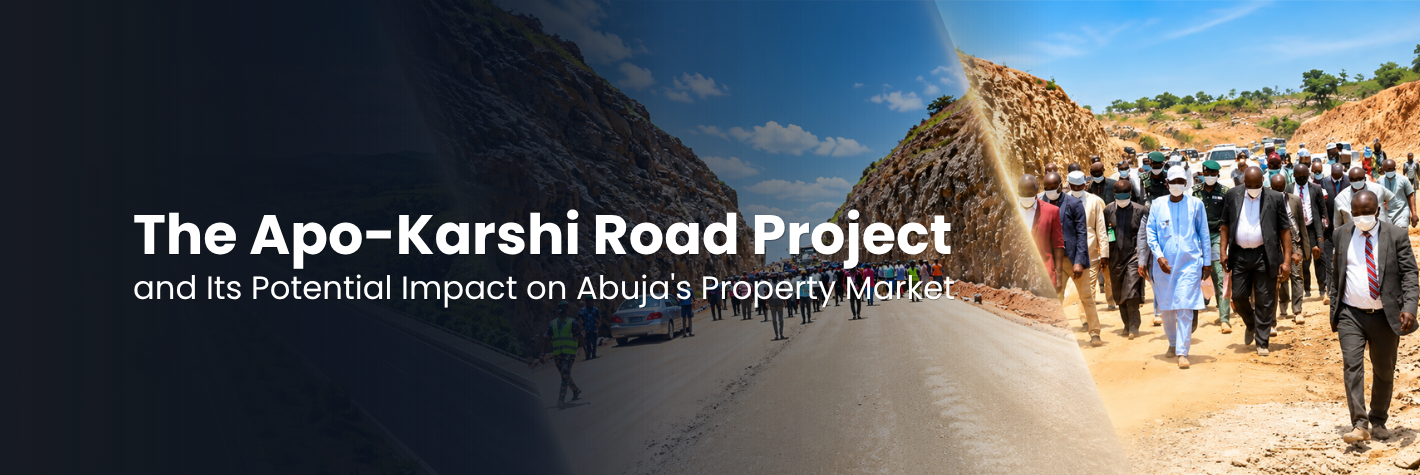
The Apo-Karshi Road is being revived and construction has progressed significantly. The Federal Capital Territory Administration has stated that the approximately 13.5-kilometre road is targeted for completion and inauguration before the end of 2026.
So what could this mean for Abuja’s property market?
Could improved connectivity make the surrounding areas more attractive to homebuyers?
Could developers begin looking more closely at the corridor?
Could land prices respond to increased demand?
And perhaps most importantly:
Should you be buying property in the area simply because the road is coming?
Let’s look at what the project could actually mean.
What Is the Apo-Karshi Road Project?
The Apo-Karshi Road is a major road project designed to improve connectivity between the Apo area and Karshi, linking communities and satellite settlements along the corridor.
The project has had a long and complicated history.
It was originally awarded more than a decade ago but remained incomplete for years. The FCT Administration eventually terminated the previous contract and re-awarded the project to SCC Nigeria Limited, with work subsequently resuming.
In August 2026, FCT Minister Nyesom Wike said the road had reached an advanced stage and was expected to be completed and inaugurated around November. Earlier statements had placed the completion target around December 2026.
The important point for property buyers is not simply that a road is being constructed.
It is what improved connectivity could do to the communities connected by that road.
Why Roads Matter to Real Estate
Real estate is heavily influenced by accessibility.
You can have a beautiful house.
A large plot.
Good title documentation.
A well-planned estate.
But if getting there is consistently difficult, the property’s appeal can be limited.
This is why infrastructure and real estate tend to move together.
A better road can make it easier for:
Residents to commute
Workers to travel
Developers to move construction materials
Businesses to serve new communities
Emergency services to access neighbourhoods
Tenants to reach homes
Buyers to inspect properties
Construction projects to become more commercially viable
The FCT Administration itself identifies roads and other infrastructure as important to the development of satellite towns, including Karshi. Its satellite-town infrastructure programme includes roads, water supply, drainage, electricity, street lighting and telecommunications infrastructure.
That tells us something important:
A road is rarely just a road.
It can become the infrastructure around which further development happens.
What Could the Apo-Karshi Road Mean for Property Prices?
This is where we need to be careful.
It is tempting to say:
“The road will be completed, therefore property prices will increase.”
Real estate doesn’t work quite that simply.
A road can increase the attractiveness and accessibility of an area, which can increase demand.
But whether that demand translates into higher property values depends on several other factors.
These include:
Exact location
Land title
Infrastructure
Development activity
Housing demand
Availability of amenities
Transport options
Plot size
Land use
Quality of the property
Developer reputation
Supply of competing properties
So the better statement is:
Improved infrastructure can create conditions that support stronger property demand.
It does not guarantee that every plot along the road will appreciate.
Apo-Karshi Could Become More Accessible to Abuja’s Wider Population
One of the biggest potential effects of the project is simple:
Accessibility.
A location that feels far away because of poor roads can feel considerably closer when the journey becomes easier and more predictable.
Think about the difference between:
“It is 20 kilometres away.”
and
“I can get there in a reasonable amount of time.”
For someone buying a home, the second question is usually more important.
People don’t live in kilometres.
They live in commute times.
If the Apo-Karshi corridor becomes easier to navigate, some buyers who previously excluded the area from their property search may begin to reconsider it.
That could expand the pool of potential buyers and residents.
Developers May Begin Looking More Closely at the Corridor
Infrastructure can also influence developers.
Developers need more than available land.
They need access.
They need construction logistics.
They need buyers.
They need tenants.
And they need confidence that the surrounding area can support development.
Improved road infrastructure can make it easier to move:
Cement
Blocks
Steel
Equipment
Labour
Building materials
Heavy machinery
It can also make completed developments easier for buyers and tenants to access.
This could encourage more residential projects along parts of the wider Apo-Karshi corridor.
But again, development will not happen uniformly.
One location may attract significant development while another remains relatively undeveloped.
The road creates opportunity. The exact location determines how that opportunity plays out.
What About Land Prices Around Apo-Karshi?
This is probably the question most property buyers want answered.
But there is no single “Apo-Karshi land price.”
Property prices can vary significantly from one location to another.
A plot closer to an established road, developed neighbourhood or major amenity may have a very different price from a similar-sized plot farther away.
The same applies to title.
A plot with stronger documentation and clearer development status cannot automatically be compared with a cheaper property whose documentation is uncertain.
So if you are seeing advertisements saying:
“Buy now before the Apo-Karshi Road is completed!”
don’t let the urgency replace due diligence.
Ask:
Where exactly is the property?
How far is it from the completed road?
What is the access route?
What is the title?
What infrastructure already exists?
What infrastructure is actually being developed?
Those questions are more useful than simply asking whether the property is “close to Apo-Karshi Road.”
The Road Could Affect More Than Land
It is easy to think of infrastructure’s impact purely in terms of land prices.
But the effects can extend across the wider property market.
Residential Property
Improved access can make homes more attractive to people who commute to other parts of Abuja.
Rental Property
If more people begin living and working around the corridor, rental demand could increase in locations that provide convenient access.
Commercial Property
Businesses often follow population.
More residents can create demand for:
Shops
Restaurants
Schools
Clinics
Supermarkets
Pharmacies
Service businesses
Development Land
Developers may become more interested in larger parcels where residential or mixed-use projects can be developed.
This is how infrastructure can gradually create a property ecosystem, rather than simply increasing the value of individual plots.
But Don’t Confuse a Road With a Fully Developed Neighbourhood
This is one of the biggest mistakes property buyers can make.
A completed road is important.
But people need more than roads.
They need:
Electricity
Water
Drainage
Security
Schools
Healthcare
Shopping
Public transportation
Waste management
Telecommunications
The FCT’s own satellite-town infrastructure programme recognises this broader requirement by including water, drainage, electricity, street lighting and telecommunications alongside road construction.
So if you are considering buying around Apo-Karshi, don’t just inspect the road.
Inspect the neighbourhood.
What Could Happen to Rents?
Improved accessibility can also influence rental markets.
Imagine a location where someone previously said:
“I wouldn’t live there. The commute is too stressful.”
Now imagine that the road improves and commuting becomes easier.
That person may reconsider.
Multiply that decision across hundreds or thousands of households and you can begin to see how infrastructure can influence housing demand.
Recent reporting on Abuja’s property market has already highlighted how infrastructure improvements have contributed to rising property demand and prices in several previously underserved areas. BusinessDay reported increased property activity and price pressure in locations including parts of Karshi as infrastructure investments improved connectivity.
However, higher rents are not automatic.
Rental demand still depends on:
Who wants to live there + what they can afford + what the property offers + how accessible it actually is.
Could Apo-Karshi Become a Major Residential Corridor?
Potentially.
Karshi is already one of the FCT’s designated satellite towns, and the FCTA has infrastructure programmes specifically covering Karshi’s districts.
The wider planning approach to Abuja has also long included satellite towns as part of the strategy for accommodating population growth and reducing pressure on the central city.
This creates an important context for understanding Apo-Karshi.
The question isn’t simply:
“Is there land there?”
There is.
The more important question is:
“Can the area support sustained residential growth?”
That will depend on the combination of infrastructure, population, employment access, services and housing demand.
Who Could Benefit From Improved Apo-Karshi Connectivity?
Different property buyers could benefit in different ways.
1. Homebuyers
People looking for more affordable alternatives to highly developed Abuja districts may have more options to consider.
2. Land Buyers
Those buying land with a longer holding period may be interested in areas where infrastructure is improving.
3. Developers
Developers may find improved access more favourable for residential projects.
4. Landlords
Improved accessibility could potentially broaden the pool of people willing to rent in the area.
5. Businesses
Growing residential communities can create demand for commercial services.
But none of these outcomes should be treated as guaranteed.
Should You Buy Property Because of the Apo-Karshi Road?
Not by itself.
This is probably the most important advice in this article.
A road project can be a positive signal.
It can improve accessibility.
It can attract development.
It can increase interest in an area.
But the road should be one factor in your decision—not the entire decision.
Before buying, investigate the actual property.
Check the title.
Is the documentation genuine and verifiable?
Check the location.
Where exactly is the property?
Check the access.
Can you reach it easily from the main road?
Check the land use.
Is the property approved for your intended purpose?
Check infrastructure.
What exists today?
What is under construction?
What is simply being promised?
Check the surrounding development.
Are people already building?
Are residents already living there?
Are businesses opening?
Check the numbers.
If you are buying for investment, what is your expected return?
Don’t rely on:
“The road will make it expensive.”
Build your decision around evidence.
The Difference Between Buying Early and Buying Blind
There is a major difference between the two.
Buying early means identifying a property before an area becomes fully developed while still doing proper due diligence.
Buying blind means purchasing simply because someone tells you:
“This place will soon become the next big thing.”
The first can be a strategy.
The second is speculation.
If you are considering the Apo-Karshi corridor, don’t just ask what the area could become.
Look at what is already happening.
Are roads being constructed?
Are houses going up?
Are estates being developed?
Are people moving into the area?
Are businesses opening?
Are public facilities appearing?
Those are tangible indicators.
What Should Property Buyers Watch Between Now and 2027?
The completion of the road will not be the end of the story.
In many ways, it could be the beginning of a new phase.
Watch for:
1. Completion of the Road
The first question is whether the project meets its stated completion and commissioning timeline.
2. Secondary Roads
What happens to roads connecting surrounding communities to the main corridor?
3. Utilities
Does electricity and water infrastructure keep pace with residential development?
4. New Housing Projects
Are developers increasingly launching estates and housing projects?
5. Commercial Activity
Are businesses beginning to establish themselves around growing residential communities?
6. Population Growth
Are more people actually moving into the area?
7. Property Prices
Are prices rising because of genuine demand or simply because sellers are speculating?
That last distinction is extremely important.
Apo-Karshi Road and the Future of Abuja Real Estate
Abuja’s property market is closely connected to the expansion of the city.
As established districts become more expensive and developed, buyers naturally begin looking at areas further from the traditional centre.
Infrastructure determines how practical those areas become.
The Apo-Karshi Road therefore matters for more than transportation.
It forms part of the broader story of how Abuja expands.
If the road is completed successfully and supporting infrastructure follows, the corridor could become more integrated into Abuja’s wider residential and economic network.
But development is rarely instantaneous.
A road can be completed in months.
A neighbourhood can take years to mature.
That distinction is important for anyone buying property with a long-term view.
What Does This Mean for Property Buyers in Abuja?
The biggest lesson from the Apo-Karshi Road project is simple:
Infrastructure changes the map.
An area that previously felt inaccessible can become more connected.
A location that developers previously overlooked can become more interesting.
A neighbourhood that struggled to attract residents can become easier to live in.
And a property market that was relatively quiet can become more competitive.
But infrastructure alone doesn’t determine whether a property is worth buying.
The property, title, location, infrastructure, price and demand all have to make sense together.
Final Thoughts
The Apo-Karshi Road project is one of the infrastructure developments worth watching as Abuja continues to expand.
After years of delays, the project has been re-awarded, construction has progressed and the FCT Administration has set a 2026 completion target.
If that target is achieved, improved connectivity could make the wider corridor more attractive to residents, developers, businesses and property buyers.
But don’t make the mistake of seeing the road and immediately seeing profit.
See the road. Then look at everything around it.
Look at the infrastructure.
Look at the development.
Look at the demand.
Look at the title.
Look at the price.
Look at the actual property.
Because in real estate, a promising location is only the beginning of the conversation.
Frequently Asked Questions About the Apo-Karshi Road and Abuja Property Market
What is the Apo-Karshi Road?
The Apo-Karshi Road is a major road project in the Federal Capital Territory intended to improve connectivity between Apo, Karshi and communities along the corridor.
How long is the Apo-Karshi Road?
The project is approximately 13.5 kilometres long.
When will the Apo-Karshi Road be completed?
As of August 2026, the FCT Minister has stated that the project is targeted for completion and inauguration around November–December 2026. The exact delivery date remains subject to completion of the works.
Will the Apo-Karshi Road increase property prices?
It could contribute to increased demand and property values in some locations by improving accessibility. However, it does not guarantee price appreciation. Property values will still depend on exact location, title, infrastructure, demand and other market factors.
Is Karshi a satellite town?
Yes. Karshi is one of the satellite towns designated for development by the FCT Administration.
Should I buy land because of the Apo-Karshi Road?
The road should be considered as one factor, not the sole reason for buying. Buyers should independently verify title, location, land use, access, infrastructure, development and total acquisition cost.
What areas could benefit from the Apo-Karshi Road?
The potential impact is not limited to one neighbourhood. Communities and developments with practical access to the corridor could benefit from improved connectivity, although the extent will depend on their exact location and supporting infrastructure.
Is the Apo-Karshi area good for investment?
There is no universal answer. Investment suitability depends on the specific property, acquisition price, title, infrastructure, demand, holding period and investment objective. Buyers should assess individual properties rather than treating the entire Apo-Karshi corridor as one market.