
If you have been searching for Ketti-Kabusa on a map and wondering what the area is actually like, you are not alone.
For years, Ketti and Kabusa were names that many Abuja residents knew without necessarily knowing much about the real estate story developing around them.
Today, that is changing.
New roads are improving access. Residential developments are appearing across the corridor. More property listings are coming onto the market. And buyers who previously focused only on established Abuja districts are beginning to ask more practical questions:
Where exactly is Ketti-Kabusa?
What is the area like?
How much does land cost?
What kind of properties are available?
How accessible is it?
What infrastructure is there?
And what should you know before buying property there?
This guide answers those questions—and more.
Whether you are considering buying land, building a home, developing property, renting, or simply trying to understand this part of Abuja, here is what you need to know about Ketti-Kabusa real estate in 2026.
Where Is Ketti-Kabusa Located?
Ketti-Kabusa refers broadly to the corridor connecting Ketti and Kabusa within the Federal Capital Territory.
Kabusa is located within the Abuja Municipal Area Council (AMAC), while Ketti is part of the wider Ketti District area of Abuja. The two locations are connected by the Kabusa-Ketti road, which has become an important part of the area’s accessibility story.
The easiest way to understand Ketti-Kabusa is not to think of it as one single neighbourhood.
It is better understood as a developing corridor made up of communities, residential developments, estates and surrounding districts.
That distinction matters when you are looking at property.
Two properties advertised as being in “Ketti-Kabusa” can have completely different access roads, surroundings, infrastructure and development levels.
So when someone tells you:
“I have land in Ketti-Kabusa.”
Your next question should always be:
“Where exactly?”
Ketti vs Kabusa: Are They the Same Place?
No.
Although the names are often used together because of their proximity and the road connecting them, Ketti and Kabusa are distinct locations.
Kabusa is an established community/district within AMAC, while Ketti refers to a wider district and surrounding area.
The Kabusa-Ketti road has strengthened the physical connection between the two areas, which is one reason property conversations increasingly refer to them together.
The road project was commissioned in 2025 after construction of approximately 10 kilometres of road connecting the communities along the corridor. The Federal Government said the project was intended to improve mobility and integrate communities while supporting economic activity.
So when you see a property advertised as:
“Ketti-Kabusa”
don’t assume that means it is located at a particular point.
Always request the exact estate name, plot number, coordinates and access route.
What Is Ketti-Kabusa Like?
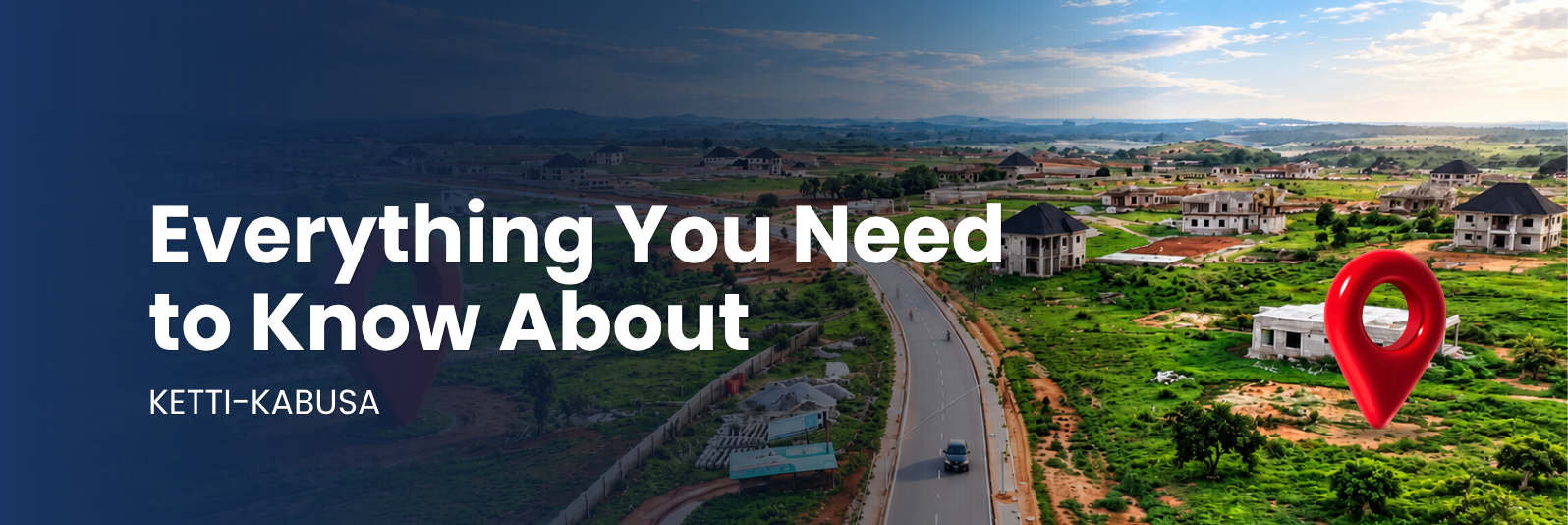
Ketti-Kabusa is best described as a developing part of Abuja with a mixture of established communities, newer residential developments and undeveloped land.
This gives the area a different character from central Abuja.
You are less likely to find the dense concentration of established commercial activity associated with districts such as Wuse or the highly developed residential environment associated with Maitama.
Instead, the landscape changes depending on where you are.
You can find:
Existing homes
New residential estates
Empty plots
Large parcels of land
Local businesses
Developing access roads
Construction activity
New housing projects
Agricultural and less-developed areas
That mixture is typical of an urban expansion corridor.
And it is important for anyone considering property there because development is not uniform.
One part of Ketti can look significantly different from another.
Why Are People Paying More Attention to Ketti-Kabusa?
There isn’t one single reason.
It is a combination of accessibility, urban expansion, infrastructure and development activity.
The biggest change has been the improvement in road connectivity.
The Kabusa-Ketti road project was initiated to improve access to communities along the corridor, and the completed road was commissioned in 2025. Government communications around the project specifically linked it to improved connectivity, security and socioeconomic activity.
This matters because roads influence real estate in very practical ways.
A road can make it easier for:
Residents to commute
Developers to move building materials
Businesses to operate
Emergency services to reach communities
Contractors to access construction sites
Buyers to inspect properties
Tenants to travel to work
But there is an important distinction:
A new road does not automatically make every property along the corridor valuable.
The specific location still matters.
The Kabusa-Ketti Road and Real Estate
If you are researching property in this area, you will probably encounter the Kabusa-Ketti road repeatedly.
And there is a reason.
The road has changed the practical relationship between communities along the corridor.
Before infrastructure improves, distance is not simply measured in kilometres.
It is measured in:
time + road condition + transport difficulty + accessibility.
A property may be physically close to another district but feel much farther away if the route is difficult.
When connectivity improves, that equation changes.
This is one reason infrastructure should always be considered when researching an emerging real estate location.
But don’t make the mistake of buying a property simply because an agent says:
“The new road is nearby.”
Check it yourself.
How far?
Which route?
How accessible is the property from the road?
What is the condition of the inner road?
Those details can make a significant difference.
What Types of Property Are Available in Ketti-Kabusa?
The property market in the area is not limited to one type of buyer.
Depending on the exact location, you may encounter:
Residential Land
This is one of the most visible property categories in the area.
Listings currently include plots marketed for residential development, including smaller plots within estate developments.
Houses
There are also houses and planned residential developments marketed within the wider Ketti area.
These can include:
Terraces
Detached homes
Semi-detached homes
Apartments
Buy-and-build properties
Estate Developments
A growing number of developers are packaging land into planned residential estates.
These may offer:
Defined plot sizes
Estate layouts
Internal roads
Security
Infrastructure packages
Flexible payment plans
But buyers should independently verify what is actually included.
“Estate infrastructure” can mean very different things from one developer to another.
Large Development Parcels
Ketti also appears in listings involving significantly larger parcels intended for development.
For example, current listings include a 57-hectare mixed-use parcel in Pyakasa, Ketti District, marketed with an FCDA C of O.
This demonstrates that the area’s real estate market extends beyond individual residential plots.
How Much Is Land in Ketti-Kabusa?
This is where you need to be careful.
There is no single price for land in Ketti-Kabusa.
Current property listings show significant variation.
For example, recent listings include residential plots around the Ketti/Kabusa corridor advertised from roughly ₦4.5 million to ₦7.5 million and above, depending on the estate, plot size and exact location. Other listings involve substantially larger parcels priced on a completely different scale.
These figures should not be interpreted as an official market valuation.
They are asking prices from property listings.
The actual value of a particular plot can depend on:
Plot size
Exact location
Title
Accessibility
Road frontage
Estate infrastructure
Land use
Development around the property
Payment terms
Documentation
Demand
Developer reputation
So instead of asking:
“How much is land in Ketti?”
Ask:
“How much is a 300sqm/400sqm/500sqm plot in this exact part of Ketti, with this specific title and this level of infrastructure?”
That question will give you a much more useful answer.
What Determines Property Prices in Ketti-Kabusa?
Two plots can be only a few minutes apart and still have very different values.
Here are some of the factors that matter.
1. Exact Location
“Ketti” is too broad to determine value by itself.
A property closer to a major road or established development may command a different price from one farther inside an undeveloped area.
2. Plot Size
A 150sqm plot obviously cannot be compared directly with a 500sqm plot.
Always compare properties on a like-for-like basis.
3. Title
Documentation can have a major effect on property value and buyer confidence.
4. Accessibility
How easy is it to get to the property?
A good location with poor access can be less attractive than a slightly more distant property with good roads.
5. Infrastructure
Roads, drainage, electricity, water and security all influence usability.
6. Development Around the Property
A plot surrounded by active development may have a different market profile from an isolated parcel.
7. Land Use
Residential, commercial, mixed-use and other land uses have different development implications.
What Is Infrastructure Like in Ketti-Kabusa?
Infrastructure varies significantly across the corridor.
The main Kabusa-Ketti road is an important completed infrastructure project, but inner roads and services can vary by community and estate.
This is why you should never judge infrastructure based only on the road you use to reach the general area.
Your actual property may be several turns away from the main road.
Before buying, inspect:
Main access road
Internal estate roads
Drainage
Electricity
Water
Street lighting
Telecommunications
Waste management
Security
And ask a very simple question:
“Is this already available, currently being constructed, or merely promised?”
Those are three very different things.
What About Electricity and Water?
This is another area where buyers should investigate property-specific conditions.
Infrastructure availability can differ considerably between an established community and a newly developing estate.
Don’t assume:
“There is electricity in Ketti.”
That does not necessarily mean there is reliable electricity at your specific property.
Likewise, water availability can depend on the development and its infrastructure.
Ask the developer or seller:
What is the current power arrangement?
Is there a transformer?
Is there a dedicated power solution?
What is the water source?
Is there a borehole?
Is water reticulated across the estate?
Are infrastructure costs included?
And, most importantly:
Verify the answers on site.
What Is the Road Access Like?
The Kabusa-Ketti road has significantly improved connectivity along the corridor.
But the main road is only one part of the equation.
Think of accessibility in three layers:
Layer 1: Abuja to the corridor
How do you get from your current location to Ketti-Kabusa?
Layer 2: Main road to the property
How do you leave the major road and reach the estate or community?
Layer 3: Inside the property
What are the roads actually like around the plot or house?
Layer three is often overlooked.
A property may be advertised as:
“Along Kabusa-Ketti Road.”
But the actual plot could be several kilometres from the paved road.
Always inspect the final stretch.
What Amenities Are Available Around Ketti-Kabusa?
Because the area is developing, amenities are not distributed evenly.
Depending on the specific part of the corridor, residents may rely on surrounding communities for some services.
When evaluating a property for residential purposes, identify the nearest:
Schools
Hospitals and clinics
Pharmacies
Markets
Supermarkets
Places of worship
Fuel stations
Restaurants
Banking/ATM services
Transport connections
Recreational facilities
The question isn’t whether one of these exists somewhere in Ketti.
The question is:
How far is the nearest one from the property you are considering?
That is the information that matters to someone who will actually live there.
Is Ketti-Kabusa a Good Place to Live?
There isn’t a universal answer.
It depends on what you value.
For someone who wants:
A quieter environment
More space
Newer residential developments
Access to emerging communities
A developing neighbourhood
the area may be appealing.
For someone who needs:
Immediate access to established commercial districts
Extensive shopping options
Mature public infrastructure
Short commuting distances to central Abuja
the experience may be different.
This is why a property guide should not simply label an area “good” or “bad.”
The better question is: good for whom?
What Are the Advantages of Living in Ketti-Kabusa?
Several characteristics may appeal to residents and property buyers.
Developing Environment
Parts of the corridor are still developing, which means buyers can find newer estates and residential projects.
Improved Connectivity
The Kabusa-Ketti road has strengthened road connectivity between the communities.
Variety of Property Options
The market includes smaller residential plots as well as houses and larger development parcels.
More Space
Compared with highly developed central districts, emerging areas can offer opportunities for larger plots and lower-density development.
Growing Development Activity
New projects can gradually bring more residents, services and commercial activity into the area.
What Are the Challenges?
A good real estate guide should also tell you what not to overlook.
Infrastructure Is Uneven
Not every part of the corridor has the same level of development.
Commute Time
Your actual travel time will depend heavily on where you are coming from and the exact property location.
Amenities May Be Further Away
Some everyday services may require travelling to nearby established areas.
Development Takes Time
An emerging area does not become fully developed overnight.
Property Information Can Be Inconsistent
Different agents may describe the same general area differently.
This is why site inspection and independent verification are essential.
What Should You Check Before Buying Property in Ketti-Kabusa?
This is perhaps the most important part of the guide.
A beautiful location does not compensate for a problematic title.
Before paying for land or property, investigate:
1. Title
What document covers the property?
Is the title genuine?
Can it be independently verified?
2. Ownership
Who owns the property?
Does the person selling it have the legal authority to sell it?
3. Survey
Does the survey correspond with the actual property?
Are the coordinates accurate?
4. Land Use
Is the property approved for the purpose you intend?
5. Acquisition Status
Is the land affected by any government acquisition, planning restriction or other encumbrance?
6. Access
Does the property have a legal and practical access route?
7. Estate Documentation
If buying inside an estate, what exactly are you receiving?
8. Additional Costs
Find out about:
Development fees
Infrastructure fees
Documentation fees
Legal fees
Survey fees
Agency fees
Other charges
A property advertised at one price can have a very different total acquisition cost.
Don’t Buy Ketti-Kabusa Property From a Map Alone
This deserves its own section.
Because one of the easiest mistakes to make when buying property in an emerging area is to fall in love with the location name.
You see:
“Ketti-Kabusa.”
You see:
“Close to Kabusa-Ketti Road.”
You see:
“Minutes from Abuja.”
And the property suddenly sounds perfect.
Then you visit.
The road is different from what you expected.
The neighbouring development is smaller.
The actual property is farther from the main road.
The electricity situation isn’t what you assumed.
The surrounding land is undeveloped.
This is why experienced property buyers inspect the actual plot, not just the brochure.
Before paying:
Visit.
Ask questions.
Verify documents.
Speak to people in the area.
Get independent professional advice.
Ketti-Kabusa for Different Types of Buyers
If You’re Buying Land to Build a Home
Focus on:
Access
Residential land use
Utilities
Neighbourhood development
Security
Plot size
Future surroundings
Think beyond the land.
Imagine actually living there.
Where will your children go to school?
Where will you shop?
How will you commute?
Where is the nearest hospital?
If You’re Buying for Rental Property
Your priorities change.
You need to understand:
Who the likely tenants are
What they can afford
What competing properties exist
How easy the property will be to access
Whether the location has enough demand
Expected rental income
Management costs
A property doesn’t become a good rental simply because it is cheap.
Someone has to want to rent it.
If You’re Buying Land to Hold
Your timeline becomes more important.
Ask:
What is developing around the property?
What infrastructure exists?
What infrastructure is actually funded or under construction?
What is the current demand?
What could make the area more desirable in the future?
And be prepared to hold.
If You’re a Developer
You need a much deeper analysis.
Consider:
Land use
Planning requirements
Infrastructure
Construction costs
Market demand
Development density
Exit strategy
Financing
Sales velocity
The question isn’t:
“Can I build here?”
It is:
“Can I build something here that people will actually pay for?”
Ketti-Kabusa Real Estate: What the Future Could Look Like
Abuja is not standing still.
As the Federal Capital Territory expands, areas that once sat outside the centre of everyday development can become increasingly integrated into the wider metropolitan economy.
Infrastructure is one part of that process.
Population is another.
Residential development is another.
Commercial activity follows.
But the future is not guaranteed to look the same across every part of Ketti-Kabusa.
Some locations will develop faster.
Some will take longer.
Some will attract residential communities.
Others may remain lower-density.
That is why property buyers should avoid making decisions based solely on predictions.
Look for evidence of development.
A road that already exists.
Buildings that are already being constructed.
People who already live there.
Businesses that have already opened.
Infrastructure that is already being installed.
Those are stronger signals than:
“Something big is coming.”
Is Ketti-Kabusa Worth Exploring in 2026?
If you are researching Abuja property, yes, the area is worth understanding.
But you don’t have to decide whether Ketti-Kabusa is “the best” location in Abuja.
That isn’t the right question.
The better question is:
Does a particular property in Ketti-Kabusa make sense for what I want to do?
A family looking for a home will evaluate the area differently from a developer.
A land banker will evaluate it differently from someone looking for immediate rental income.
A first-time buyer will have different priorities from a commercial developer.
The location is only one part of the decision.
The property itself matters.
Ketti-Kabusa Real Estate Guide: The Bottom Line
Ketti-Kabusa is no longer simply a name on the outskirts of Abuja.
It is a developing real estate corridor with improving connectivity, growing residential activity and a wide range of property opportunities.
The completion of the Kabusa-Ketti road has strengthened accessibility between the communities and is an important part of the area’s development story.
Current property listings also demonstrate the variety of real estate being marketed in the area—from smaller residential plots to houses and much larger development parcels.
But don’t let the development story make the decision for you.
If you’re considering property in Ketti-Kabusa, remember:
Know the exact location.
Inspect the property.
Understand the infrastructure.
Verify the title.
Confirm the land use.
Understand the total cost.
Research the surrounding development.
And most importantly:
Don’t buy the name “Ketti-Kabusa.” Buy a property that makes sense within Ketti-Kabusa.
That is the difference between simply owning property and making an informed property decision.
Frequently Asked Questions About Ketti-Kabusa
Where is Ketti-Kabusa located?
Ketti-Kabusa refers to the corridor connecting Ketti and Kabusa in the Federal Capital Territory. Kabusa is within Abuja Municipal Area Council, while Ketti forms part of the wider Ketti District.
Is Ketti the same as Kabusa?
No. Ketti and Kabusa are separate locations, although they are closely connected by the Kabusa-Ketti road and are frequently discussed together in real estate marketing.
Is there a road connecting Ketti and Kabusa?
Yes. The Kabusa-Ketti road was constructed and commissioned in 2025, improving connectivity between the communities along the corridor.
How much is land in Ketti-Kabusa?
There is no single price. Current listings show residential plots advertised at several million naira, while larger development parcels can be priced much higher. Prices depend on plot size, exact location, title, accessibility and infrastructure.
Is Ketti-Kabusa developed?
The area has a mixture of established communities, residential estates, ongoing construction and undeveloped land. Development levels vary considerably depending on the specific part of the corridor.
What types of property are available in Ketti?
Properties marketed in Ketti include residential land, houses, estate plots and larger parcels suitable for development.
Is Ketti-Kabusa suitable for building a house?
Some parts of the corridor are suitable for residential development, but buyers should confirm the exact property’s title, approved land use, planning requirements, accessibility and infrastructure before purchasing.
What should I check before buying land in Ketti?
Check the title, ownership, survey, land use, acquisition status, access, estate documentation, infrastructure and all additional costs. Independent legal and professional due diligence is strongly recommended.
Is Ketti-Kabusa a good place to live?
It depends on your priorities. The area offers developing residential environments and improving connectivity, but infrastructure and amenities vary by location. A site visit is essential before deciding whether a specific property suits your lifestyle.
Is Ketti-Kabusa a good investment?
The answer depends on the specific property, price, title, location, development and your investment objective. Ketti-Kabusa should be evaluated as a collection of different micro-locations rather than as one uniform property market.
How do I find the right property in Ketti-Kabusa?
Start by defining what you need—land, a house, rental property or development land—then compare exact locations, titles, plot sizes, infrastructure, access and total acquisition costs. Always inspect the property and independently verify its documentation before payment.
Looking to Own Property in Ketti-Kabusa?
Now that you understand Ketti-Kabusa beyond the location name, the next question may be:
Where can you actually own property in the area?
At NeoHomes Limited, we are proud to have Neo Peninsula Estate, our development located in Ketti-Kabusa, Abuja.
Neo Peninsula Estate offers buyers the opportunity to secure land within this developing corridor, with plots starting from ₦5,625,000.
Whether you are looking to build your home, secure land for the future or simply explore property options within Ketti-Kabusa, Neo Peninsula is an opportunity worth considering.
But as we have established throughout this guide, buying property is not just about finding a location or a price that looks attractive.
It is about knowing exactly what you are buying, where it is located, what comes with it and who you are buying from.
That is why at NeoHomes, we encourage prospective buyers to ask questions, understand the property, review the relevant documentation and visit the estate before making a decision.
If Ketti-Kabusa is on your property radar, Neo Peninsula Estate by NeoHomes could be your opportunity to own a piece of this growing Abuja corridor.
Starting from ₦5,625,000.
NeoHomes Limited — Peace Beyond Shelter.